Safe workflows · Updated September 17, 2026 · 8 min read
Safe Instagram automation workflows: how caps, delays, safe lists and cool-downs fit together
"Safe automation" isn't a feature — it's a stack of separate controls that each reduce one specific risk. Daily caps limit volume. Randomized delays break mechanical timing. Safe lists protect relationships. Cool-downs reset after problems. Here's how the pieces fit, and what honestly happens when you skip one.
The stack: four controls, four different risks
Most "is automation safe?" debates fail because people argue about automation as if it were one thing. It isn't. Each control below addresses a distinct failure mode:
| Control | Risk it addresses | What skipping it looks like |
|---|---|---|
| Daily caps | Volume that no real person sustains | 800 follows in an afternoon; block by evening |
| Randomized delays | Mechanical timing patterns | Actions every 30.0 seconds, around the clock |
| Safe lists | Cleanup damaging real relationships | Auto-unfollow removes your best customer |
| Cool-downs | Pushing through warnings | Retrying during a block until it hardens |
Daily caps: ceilings, not targets
Instagram has never published official per-day action limits — the numbers that circulate (200 follows, 150 unfollows, 350 likes) are community-reported, as our limits guide documents. The only confirmed figure is the 7,500 total-following cap.
The practical implication: a cap is not a quota. If community reports put new accounts around 50-100 follows per day community-reported, a conservative setup treats that as the outer edge — and runs well below it. Our own product defaults follow this logic: plan caps of 10-250 per action per day are product limits, deliberately under the reported ceiling, and users can set lower personal caps (see how tool types differ).
Randomized delays: boring is the goal
Instagram's detection focuses heavily on action velocity and regularity — accounts that act too fast, too consistently, or at hours no human would. Kicksta's overview of balanced automation describes tools being flagged precisely for repeating actions "without human pacing" (kicksta.co). A glossary maintained by the Feedflux team makes the same point: detection weighs action velocity more than raw counts (feedflux.app).
Randomized delays — variable gaps between actions, quiet hours at night, jitter around every interval — deliberately make automation slower and less regular. That's the trade working as intended.
Safe lists: never unfollow your mother
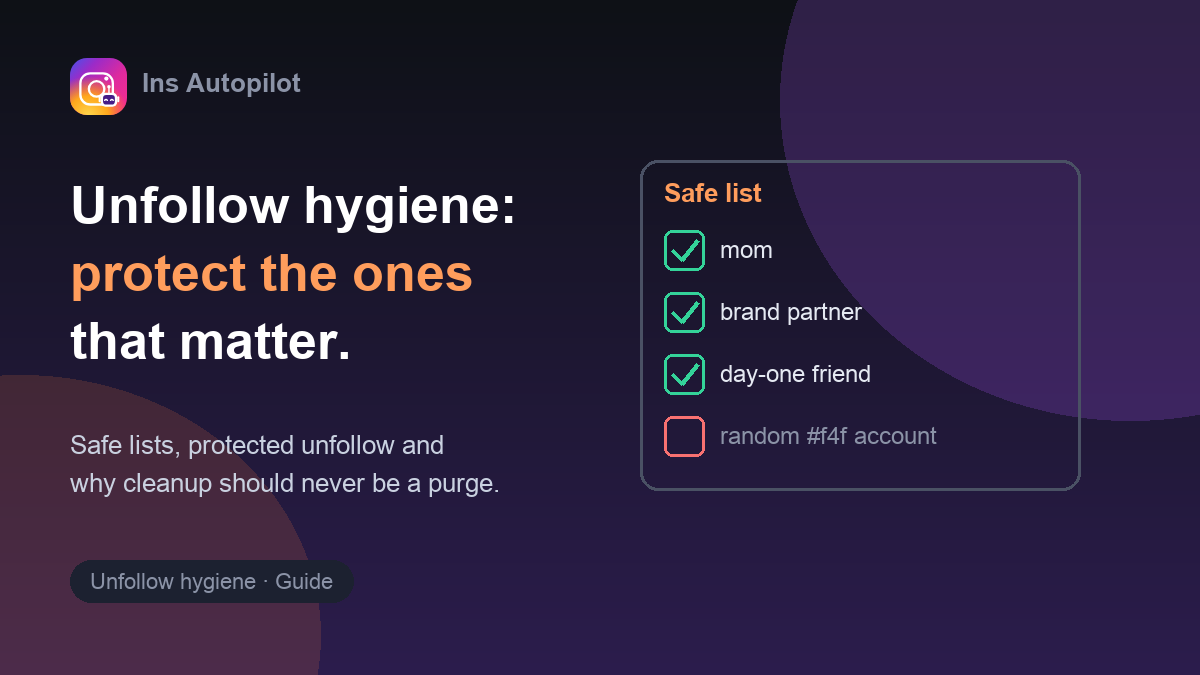
Any workflow that includes unfollowing needs a protected set: family, close friends, brand partners, customers, collaborators. A safe list is simply a list of accounts the tool will never unfollow (and often never mass-engage). Without one, an aggressive "clean up non-followers" run can remove relationships you actually care about — a real cost that has nothing to do with account safety. Our unfollow tools comparison lists safe-list support as a selection criterion.
Cool-downs: when to stop and what to do after
- Stop immediately when Instagram shows an action block, challenge or error. Retrying through a warning converts a short block into a longer one.
- Cool down 48-72 hours after a block clears before resuming — at reduced volume (often half your previous cap).
- Ramp back gradually. Sudden restarts at full volume repeat the exact pattern that triggered the block.
- If a block message includes a "tell us" or report option, Instagram's own Help Center is the channel for disputing mistakes — not repeated automation retries.
For a deeper dive into block types and timelines, see our action block guide.
A conservative weekly routine, assembled
| Day | Activity | Why |
|---|---|---|
| Mon | Review stats; adjust caps down if any warning appeared | Weekly reflection beats daily tinkering |
| Tue-Sat | Automation runs under caps, with delays, safe list on | Steady, boring, sustainable |
| Sun | Light manual engagement; no automation or low volume | Humans use Instagram on Sundays too — variably |
| Any block | Full stop → 48-72h cool-down → resume at half volume | See cool-downs above |
No configuration makes automation "safe." Conservative configuration makes it less risky — and keeps you under the patterns that get accounts restricted fastest.
Frequently asked questions
What daily cap should I start with for Instagram automation?
Community-reported conservative ranges start around 50-100 actions per day for newer accounts. Treat published numbers as ceilings reported by users, not official figures, and stay well below them while an account is young.
Why do automated actions need randomized delays?
Detection weighs velocity and regularity. Fixed intervals look mechanical; varied gaps look more like a person. Delays reduce speed — that's the point.
What is a safe list in Instagram automation?
Accounts the tool will never act on — close friends, family, partners, customers. It stops cleanup runs from unfollowing relationships that matter.
Do cool-downs actually help?
Yes as harm reduction: pausing after blocks or bursts lets an account return to normal behavior, and resuming at reduced volume avoids repeating the triggering pattern.