Audience targeting · Updated September 17, 2026 · 7 min read
How to target the right audience on Instagram (2026 guide)
Most "grow your followers" advice skips the only question that matters: who exactly are you trying to reach? Targeting the right audience on Instagram means defining a niche, finding where those people already gather, and concentrating your attention there — instead of mass-following strangers and hoping some of them care. Here's how to do it step by step.
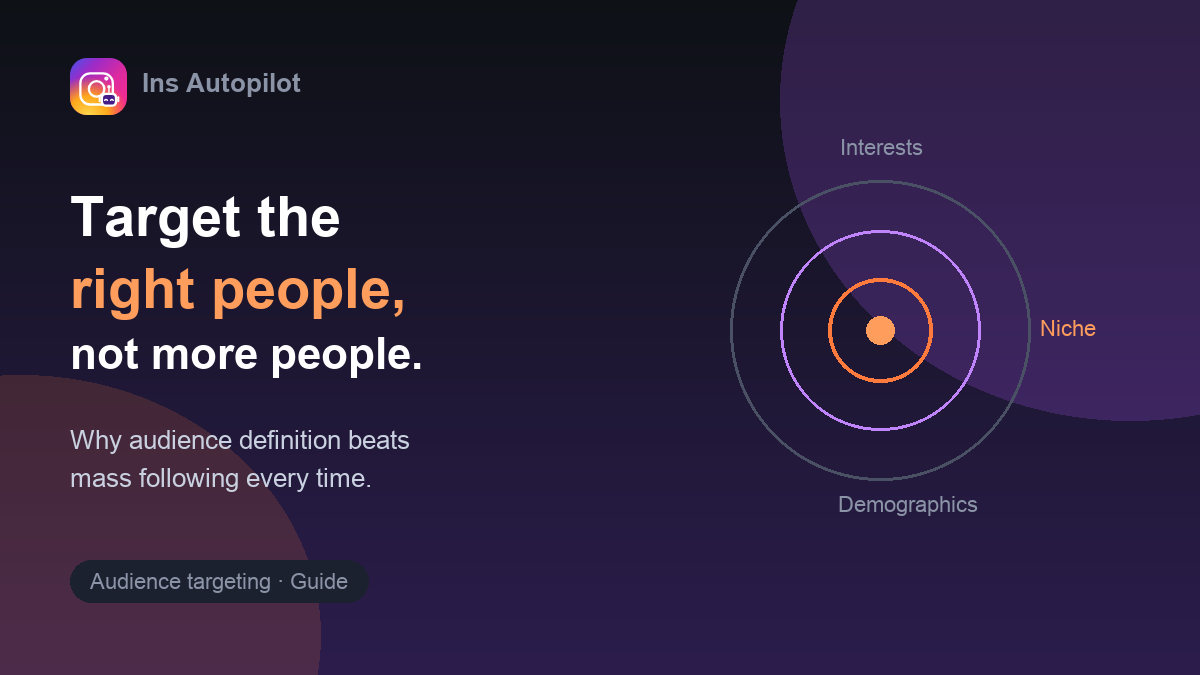
Why "right" beats "more"
An audience is only valuable if it's relevant. 300 followers who genuinely care about your niche will comment, share, and buy. 3,000 followers you mass-followed at random will scroll past everything you post — and the algorithm reads that silence as "show this to fewer people." Engagement quality feeds distribution, which is why audience definition is a growth tactic, not a branding exercise.
This is also where the 80/20 rule (widely cited Pareto principle applied to social media) shows up in practice: a small core of highly relevant accounts and communities tends to drive the large majority of your real engagement.
Step 1 — Define your niche in one sentence
Write it down: "I make content about [specific topic] for [specific group]." If you can't fill in both blanks narrowly, you don't have a niche yet — you have a topic. Sprout Social's overview of niche marketing makes the same point: the narrower the defined segment, the easier it is to become the obvious choice for it. "Fitness" is a topic. "Home workouts for new dads" is a niche.
A useful test: could a stranger guess what your next 10 posts will be about, just from your bio? If not, tighten the sentence until they could.
Step 2 — Find where your audience already gathers
You don't need to build an audience from zero — it already exists around other accounts. Three places to look:
- Niche hashtags and search terms. Search the phrases your audience would use. Instagram's own creator resources recommend studying what already performs in your content area.
- Followers of adjacent creators. Accounts with 5k–50k followers in your niche have audiences close to your size and stage — these people can realistically become mutual engagers.
- Comment sections. The people who leave thoughtful comments on big niche accounts have self-identified as engaged. That's a far better signal than a follower list.
Buffer's 2026 growth research suggests a similar method: search niche terms for creators aligned with your brand, and look for consistent engagement in comments — not just likes (buffer.com).
Step 3 — Build an engagement shortlist, not a follow list
Before following anyone, watch and engage: save posts, leave substantive comments, react to stories. A shortlist of 50 accounts in your niche that you actually interact with will do more for your reach than 500 random follows — and it produces a cleaner signal for the algorithm about who your content is for.
| Approach | What happens | Typical outcome |
|---|---|---|
| Mass-follow strangers | Irrelevant follows, low engagement back | Feed signal noise; weak distribution |
| Niche engagement shortlist | Relevant interactions, real conversations | Algorithm learns your audience; compounding reach |
| Engage, then follow selectively | Follows happen inside real context | Higher follow-back relevance and retention |
Step 4 — Let automation pace the outreach, not replace the judgment
This is the honest part: we build an automation tool, and we're still telling you that targeting is your job. Automation can pace follows, unfollows, and likes within daily caps so you don't have to click everything by hand — but deciding who is worth engaging stays human, because that decision is what separates an audience from a follower count.
If you use automation to support this workflow, keep the audience work in steps 1–3 and treat tool-driven actions as the last mile: conservative daily caps, a defined target group, and pauses when Instagram signals a problem. If you're weighing tools, our comparisons of automation tools by access model and unfollow tools cover what each type can and can't do safely.
"Target the right people, not more people." A defined audience compounds; a big one just sits there.
Content mix: what the classic rules actually say
Two frameworks from the PAA sphere come up constantly. Both are content-mix heuristics, not growth guarantees — and both have been widely cited, not platform-official:
| Rule | What it means | How to read it |
|---|---|---|
| 5-3-1 rule | Per day: 5 likes, 3 comments, 1 follow as a minimum-engagement habit | A pacing floor for showing up daily in your niche — see our 2026 growth guide |
| 5-3-2 rule | Per 10 posts: 5 curated from others, 3 your own brand, 2 personal/direct | Keeps a feed from being all self-promotion; variety sustains followers |
| 80/20 rule | ~80% of results come from ~20% of actions (Pareto principle) | Double down on the small set of niche communities that actually engage |
How to tell your targeting is working
- Comment quality, not follower count. Are new followers leaving words, or just emoji?
- Retention after follow-backs. If you unfollow-inactive accounts, do relevant users stay?
- Profile-visit → follow conversion. A clear niche raises this number without any extra traffic.
And a caution from our safety guide: even perfectly targeted engagement must stay under sane volume limits — targeting changes who, never how many is safe. Our limits guide has the numbers and their (community-reported) provenance.
Frequently asked questions
How do I target the right audience on Instagram?
Define your niche in one sentence, identify where your ideal followers already gather (hashtags, competitor followers, adjacent creators), and concentrate your engagement there. Depth beats breadth: 300 relevant followers outperform 3,000 random ones.
What is the 5-3-2 rule on Instagram marketing?
For every 10 posts: 5 curated from others, 3 about your brand, 2 personal or direct content. It's a posting-mix framework — widely cited, not an official Instagram rule.
What is the 80/20 rule on Instagram?
The Pareto principle applied to social media: roughly 80% of results come from 20% of actions. In targeting terms, a small core of relevant communities drives most real engagement.
Is it better to follow big accounts or small accounts in my niche?
Study the large, engage the small. Big accounts show what resonates at scale; small and mid-size accounts are where genuine mutual engagement is realistic for a growing account.