Growth strategy · Updated September 30, 2026 · 9 min read
The Instagram 5-3-1 rule: what it is and isn't (2026)
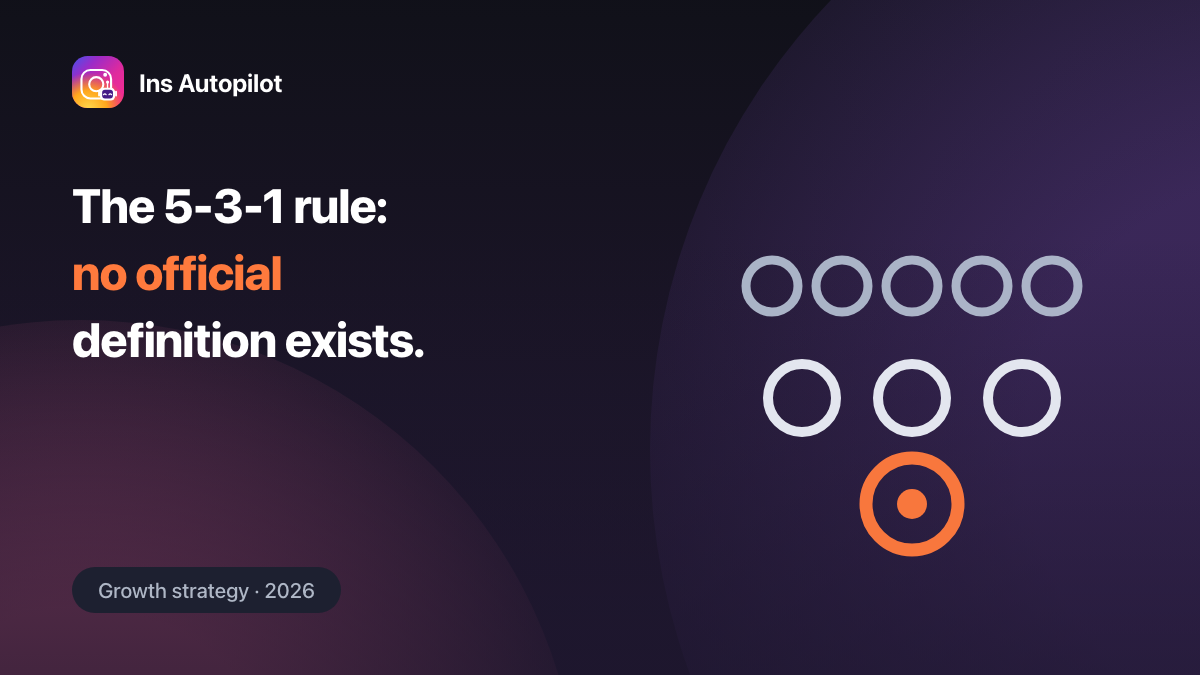
The Instagram 5-3-1 rule is usually described as a daily routine — like five posts, leave three comments, follow one account — and it is repeated on hundreds of pages. What almost none of them say is that Instagram has never defined this rule, and that the pages disagree with each other about what the numbers even describe. This guide collects the competing versions, labels every claim, and explains which part of the idea is worth keeping.
What is the Instagram 5-3-1 rule?
In its most common form it is a five-minute engagement routine: in one sitting you like five posts from accounts in your niche, leave three genuine comments, and follow one new account. Every source we could find that defines it this way is a third-party growth blog rather than an Instagram page, and the numbers are presented as advice with no attribution to the platform. There is no help-centre article, no policy page and no product feature that uses the name.
That absence is the most important fact in this guide. A rule with no publisher cannot be verified, updated or corrected — which is why the same three digits have drifted into several incompatible meanings, and why you should treat any confident statement about what it “officially” is as a sign the author has not checked.
Why do sources disagree about the 5-3-1 rule?
Because the numbers are memorable and the definitions are not. Four versions circulate, and only two of them describe the same activity. One widely-cited write-up groups it with the 3-2-1, 5-3-2 and 80/20 rules and describes it as liking five, commenting on three and following one. Another frames it as a funnel for warming cold profiles by liking five of their recent posts and commenting on three. A third keeps the shape but swaps the last step: instead of following one account, you either follow one or send one DM.
Then the same digits turn up describing something entirely unrelated. In content-strategy writing, a 5-3-2 rule means a publishing mix — 50% curated, 30% original, 20% promotional — with no engagement component at all. Same rhythm of numbers, different subject. If a page promises the 5-3-1 rule and then talks about content ratios, you are reading a conflation, not a definition.
| Version | What it prescribes | Evidence |
|---|---|---|
| Engagement routine (most common) | Like 5 posts, leave 3 comments, follow 1 account, daily | community-reported — repeated across third-party growth blogs; no Instagram page defines it |
| Warm-up sequence | Like five recent posts of one target profile, then comment on three of them | community-reported — the definition used by at least one outreach-oriented blog |
| Follow-or-DM variant | Same likes and comments, but the final step is either a follow or a DM | community-reported — a third-party variant; sources contradict each other on this step |
| Content-mix confusion (5-3-2) | 50% curated, 30% original, 20% promotional publishing mix | community-reported — a different rule that reuses the same numbers |
| “It is an official framework” | No Instagram help page, policy page or feature uses this name | Confirmed — absence in Instagram's own documentation, checked September 2026 |
| “A guaranteed growth system” | No platform publishes reply or follow-back conversion data for such a routine | unverified — a claim we could not trace to any source, official or otherwise |
| Running it at volume | Repetition across many accounts is a named spam indicator, and restrictions can apply even at lower frequencies | Confirmed — Meta's Community Standards on Spam |
Does the 5-3-1 rule work?
Its underlying idea does; the specific arithmetic does not, and neither does the promise attached to it. The idea is sound because it forces a behaviour most accounts skip: interact with people who are not already following you, in your own voice, at a pace that lets you read what you are responding to. Nobody needs a formula to do that, and the formula does not improve it.
What fails is the packaged version — five likes, three comments, one follow, every day, ideally with a tool. That converts an intention into a quota, and quotas are performed, not felt. At low volume that is merely hollow. At higher volume it becomes exactly the pattern the spam rules are written against, because repetition plus low variation is the definition of the thing they look for.
How do you run a 5-3-1 routine without risking the account?
Keep the structure and drop the schedule. Treat the numbers as a ceiling for one session rather than a daily target: at most five profiles looked at properly, three comments that say something only you could say, one follow you would still want next month. Skip the day entirely when nothing worth replying to has appeared — a routine you cannot skip is a habit you cannot trust.
Two mechanical habits keep it defensible. Never let the comments share a template; the text is what separates a person from a script, and it is also the part most easily compared across accounts. And never let the sessions run back to back — spacing is the cheapest signal you have that the activity is yours. The wider arithmetic is in safe automation workflows, and the timing patterns that precede a restriction in the bot detection signals guide.
Frequently asked questions
What is the 5-3-1 rule on Instagram?
It is a third-party engagement routine: like five posts, leave three comments and follow one new account in a single session. Instagram has never published or endorsed it, and the pages that define it do not agree on the final step — some say follow, others say follow or send a DM.
Is the 5-3-1 rule official?
No. There is no Instagram help-centre article, policy page or product feature that uses the name. Every definition we could find comes from a third-party growth blog, which is why the same three numbers are attached to several incompatible activities, including a publishing mix with no engagement step.
Does the 5-3-1 rule get you banned?
The numbers themselves do not. The pattern does: likes, comments and follows repeated at volume with little variation is what the spam rules describe, and Meta states that restrictions can apply to accounts acting at lower frequencies when repetitive content is among the indicators.
What should I do instead of following a formula?
Keep the intent and drop the quota. Read a handful of profiles in your niche, reply to things you genuinely have something to say about, and follow only accounts you expect to still care about in a month. Volume without judgement is the part that carries risk.